

Hey there! As a supplier of Pharmaceutical Printers, I've got a ton of insights into the power consumption characteristics of these nifty machines. Let's dig right in and break it down.
First off, it's important to understand that the power consumption of a pharmaceutical printer can vary quite a bit depending on several factors. One of the main things that affects power use is the type of printing technology it employs. There are different kinds out there, like inkjet, laser, and thermal transfer, and each has its own power - guzzling tendencies.
Inkjet printers are pretty common in the pharmaceutical industry. They work by spraying tiny droplets of ink onto the surface to create the desired print. These printers usually have a relatively low power consumption during standby mode. But when they're actively printing, the power usage can spike. That's because the inkjet nozzles need to be precisely controlled to eject the ink, and the pumps that move the ink around also consume energy. For smaller inkjet pharmaceutical printers, the power consumption during printing might range from 50 to 150 watts. Larger, high - volume inkjet printers, on the other hand, can use anywhere from 200 to 500 watts or more. You can check out our UV Fast Drying Ampoule Printing Machine, which uses advanced inkjet technology and has optimized power consumption for efficient operation.
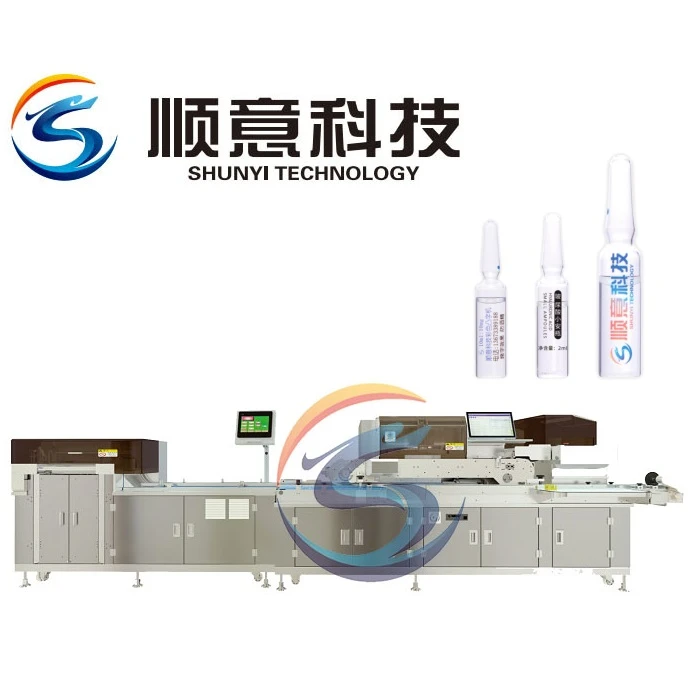

Laser printers, on the flip side, work by using a laser beam to create an electrostatic image on a drum, which then attracts toner to form the print. These printers generally have a higher power consumption compared to inkjet printers, especially during the warm - up phase. The laser unit, fuser, and other components need a good amount of power to function properly. When a laser pharmaceutical printer is warming up, it can use upwards of 800 watts. Once it's up and running, the power consumption usually drops to around 300 - 600 watts during printing. Our Pharmaceutical Packaging Printing Machine with laser printing capabilities is designed to be as energy - efficient as possible, but it's still important to be aware of these power characteristics.
Thermal transfer printers use heat to transfer ink from a ribbon onto the printing surface. The power consumption of thermal transfer printers is mainly related to the heating element. When the printer is heating the ribbon to transfer the ink, it consumes a significant amount of power. In standby mode, the power usage is relatively low, maybe around 10 - 30 watts. But during printing, it can jump to 100 - 300 watts, depending on the size and speed of the printer.
Another factor that influences power consumption is the printing speed. Faster printers generally use more power because they need to move the printing components more quickly and process the data at a higher rate. For example, a printer that can print 50 labels per minute will use more power than one that can only print 20 labels per minute.
The size of the print area also matters. A printer that can print large labels or packages will need more power to cover the larger surface area. This is because it has to move the print head over a greater distance and may need to use more ink or toner.
The duty cycle of the printer is yet another important consideration. The duty cycle refers to the number of prints a printer can handle in a given period. Printers with a high duty cycle are designed to print a large number of labels or packages continuously. These printers often have more robust components and cooling systems, which means they consume more power. A printer with a low duty cycle, on the other hand, is better suited for intermittent printing and will use less power overall.
Now, let's talk about how we, as a pharmaceutical printer supplier, are working to reduce power consumption. We're constantly researching and developing new technologies to make our printers more energy - efficient. For example, we're using advanced power management systems that can automatically adjust the power usage based on the printer's status. When the printer is in standby mode, it can reduce the power to a minimum, and then quickly ramp up when it's time to print.
We're also looking at ways to optimize the printing process itself. By using more efficient ink and toner formulations, we can reduce the amount of material needed for each print, which in turn reduces the power required to move and apply the ink or toner.
In addition, we're designing our printers with better insulation and cooling systems. This helps to keep the internal components at an optimal temperature without using excessive power for cooling.
If you're in the market for a pharmaceutical printer, it's important to consider the power consumption characteristics. Not only will this help you save on energy costs in the long run, but it's also better for the environment. Our Pharmaceutical Printer is designed with these factors in mind, offering a balance between high - quality printing and efficient power use.
So, if you're interested in learning more about our pharmaceutical printers or have any questions about power consumption, don't hesitate to reach out. We'd love to have a chat with you and help you find the perfect printer for your needs. Whether you're a small pharmaceutical lab or a large - scale production facility, we've got the right solution for you. Contact us today to start the conversation about your printing requirements and let's see how we can work together to get you the best value and performance from your printer.
References
- General knowledge of the pharmaceutical printing industry
- In - house research and development data on printer power consumption